Every Shopify store wants AI to name it the best. But three stores selling nearly the same catalogue do not start from the same place.
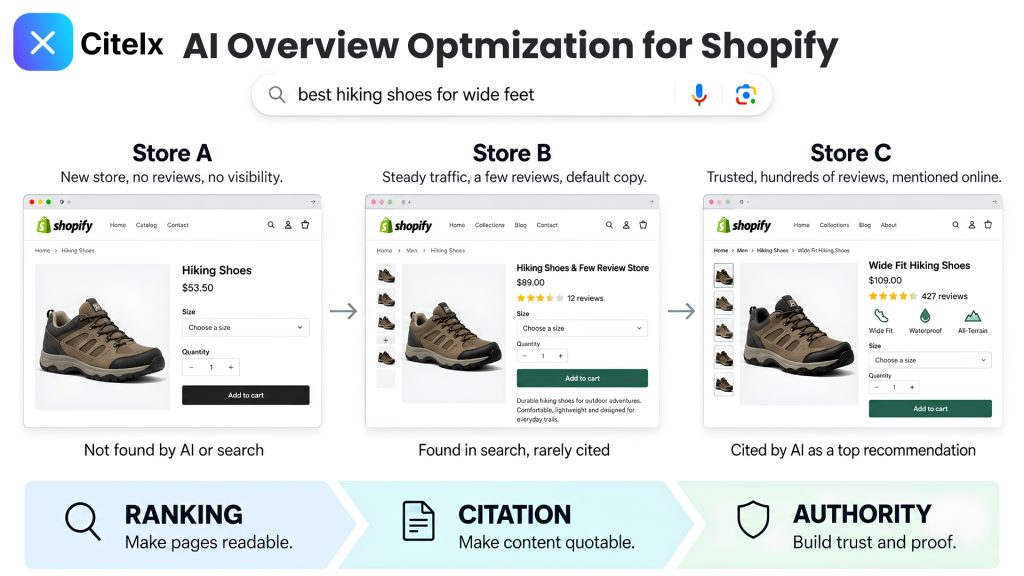
Picture three hiking-shoe stores, all chasing the query “best hiking shoes for wide feet”:
- Store A just opened, with no reviews, no mentions, and no visibility at all.
- Store B has steady traffic and a handful of reviews, but coasts on default copy.
- Store C is already trusted, with hundreds of reviews, and people mention it in hiking forums without being asked.
Ask an AI that query today and Store C wins easily. That looks like luck, but it isn’t. Nobody handed Store C its spot, and nothing locks the others out of it. All three are on the same ladder, Store C simply climbed higher, rung by rung, and every one of those rungs can be climbed on purpose. Here’s the plan for each.
The Ladder: Ranking, Citation, Authority
Three rungs, and they only work in order. Each one holds up the next, so skipping ahead just means the top rung has nothing underneath it.
- Ranking. Can search and AI find your pages and understand them? Until they can, you’re invisible, and invisible stores don’t get recommended.
- Citation. Is your content clear enough to be lifted off the page and repeated as the answer? This is the gap between existing and being quoted.
- Authority. Do enough real buyers and outside platforms vouch for you that AI trusts you by default? This is the rung that earns the word best.
Don’t reach for the top rung early. Chasing authority while your pages still can’t be read just burns budget. You can’t be trusted for an answer you were never legible enough to give.
And here’s what turns this from a checklist into a strategy: the rungs stack. You don’t swap one stage’s work for the next, you keep it and build on top. Store A’s clean pages become the surface Store B’s reviews stand on, and Store C runs all of it at once.
Store A: From Invisible to Readable
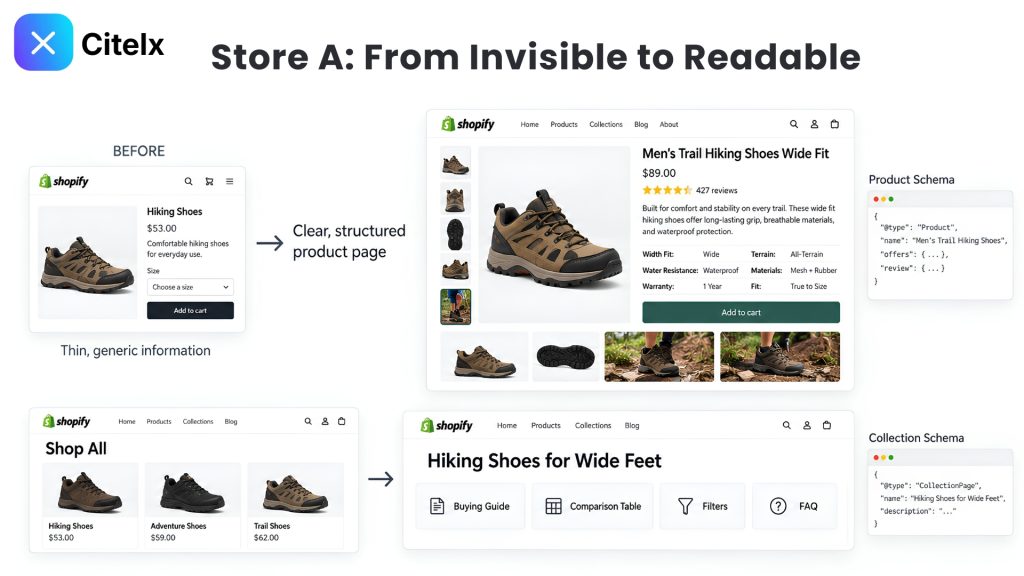
Where you stand right now is new and invisible, not because AI has anything against you, but because your pages read exactly like every other retailer’s selling the same shoe. When the text is identical everywhere, an engine has no real reason to pick yours over the rest. The fix is to rebuild the two page types that carry your entire catalogue, so a machine can make sense of them and sort them correctly. This is the groundwork every stage after this one depends on.
Product pages
A product page’s job now is to give a machine enough to describe the shoe to someone who will never see it. These are the elements that move the needle:
- A title built to be parsed, not admired. Brand, product, key attribute, fitment, front-loaded and under about 60 characters so the meaning survives truncation on a phone. Not “Premium Quality Hiking Shoe, Best Seller.”
- A description written to be quoted. Two sentences up top: what the shoe is, who it fits, and the one thing the alternative doesn’t have, written in measurements and materials rather than “premium” and “durable.” This is the block an assistant lifts whole.
- Cover unique and micro topics. Use tools like AnswerThePublic or Google’s People Also Ask to find the small questions buyers actually ask, then answer them right on the page.
- The 30 to 60 facts, not the usual six. Width fit, terrain, break-in time, water resistance, warranty. Google builds its filter chips from these, so a missing attribute doesn’t get you outranked, it drops you out of the filtered result entirely, even when you qualify.
- Images that answer questions. A scale reference, an in-use shot, and a detail macro, plus descriptive filenames and alt text. Each one pre-empts a return.
- Reviews and honest schema. Pin the review that answers a buyer’s real doubt, and mark up Product, Offer, Variant, and Review completely, with no fake ratings and no false stock.
These are the elements that matter most. The full breakdown covers all 16, with the exact fixes for each, on Product Page Optimization. For the nine-shot image set and the Merchant Center steps that go with it, see How to Get Your Products into Google AI Overviews.
Collection pages
A category page should help someone choose, not just stack forty products in a grid, because that grid is exactly where “best hiking shoes for wide feet” lands. If it’s only products, the shopper leaves to ask AI, which names whoever bothered to explain the difference.
- A heading buyers actually type, like “Hiking Shoes for Wide Feet,” not “Shop All.”
- Two sentences above the grid, and a real buying guide below it. This guide, covering how to choose what suits which use, and what to avoid, is the part almost no one bothers to publish, and exactly the part AI loves to quote.
- A comparison table built around use cases, shaped by the buyer’s situation rather than your SKUs. A real, properly marked-up table is the single most quotable thing you can put on the page.
- Filters on the attribute that decides the purchase, shown with counts and real values, like “Waterproof (18),” not just S/M/L.
- A pre-purchase FAQ along with Collection Page schema, so the page reads like a curated set someone put thought into, not just a loose pile of products.
These are the ones that matter most. For the complete list of all 10 elements, laid out one by one, see Collection Page Optimization.
The result: your pages rank for the searches that used to skip you, and they’re clear enough to be quoted. That base is Store B.
Store B: Get Quoted, Not Just Found
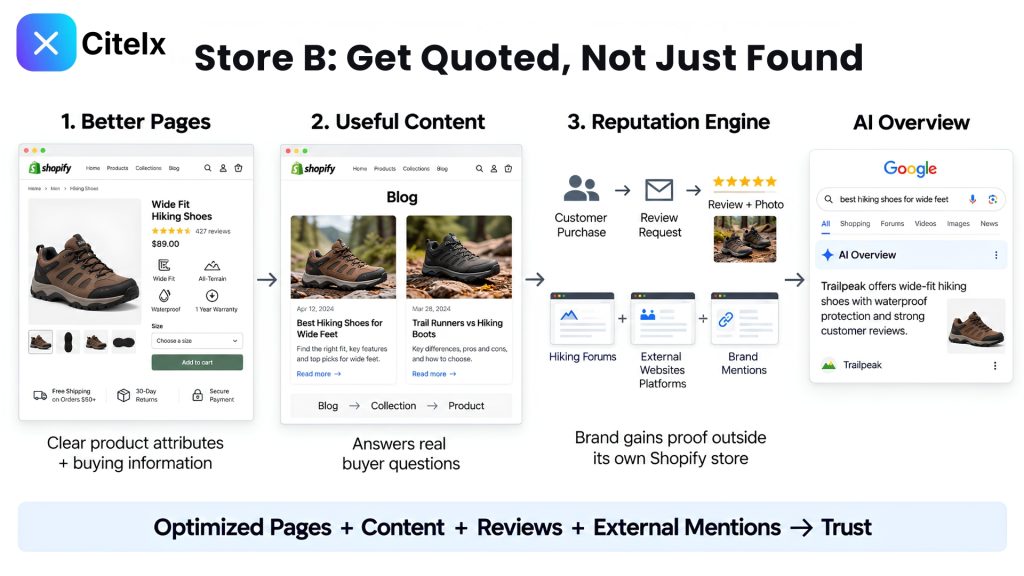
Where you stand right now, people find you, but AI still quotes your competitors. The pages work, they just need to work harder.
Keep sharpening the pages and start a blog. The product and collection work from the last stage never stops, so keep filling attribute gaps and tightening titles. Then add the content AI loves to quote, like comparison posts and buying guides that answer the exact questions shoppers ask, such as trail runners vs hiking boots or best shoes for wet trails. Link each post to the collection and products it covers, so the blog feeds them instead of sitting alone.
A reviews system, not luck
Most stores wait and hope. Build a loop instead.
- Ask on delivery: a follow-up email, a small discount for a review, a little extra for a photo.
- Ask something specific, like “How did they feel on your first hike?”, to get answers you can actually use.
- Pin the review that answers a buyer’s real doubt, and leave negatives up, answered in public.
- Mine reviews to feed your FAQs, pain points, and missing attributes. Your buyers have already written your best copy.
Reputation management
Reviews on your own site aren’t enough, because an AI checks the wider web first.
- Show up where your category is discussed, so a private review becomes a public mention AI can find.
- Keep your name, price, and details identical everywhere they appear.
- Never fake it. It’s easy to spot, breaks platform rules, and destroys the exact trust you were building.
The result: your pages answer the question and the outside world backs them up, so AI starts citing you by default. That’s Store C.
Store C: Keep the Seat You’ve Earned
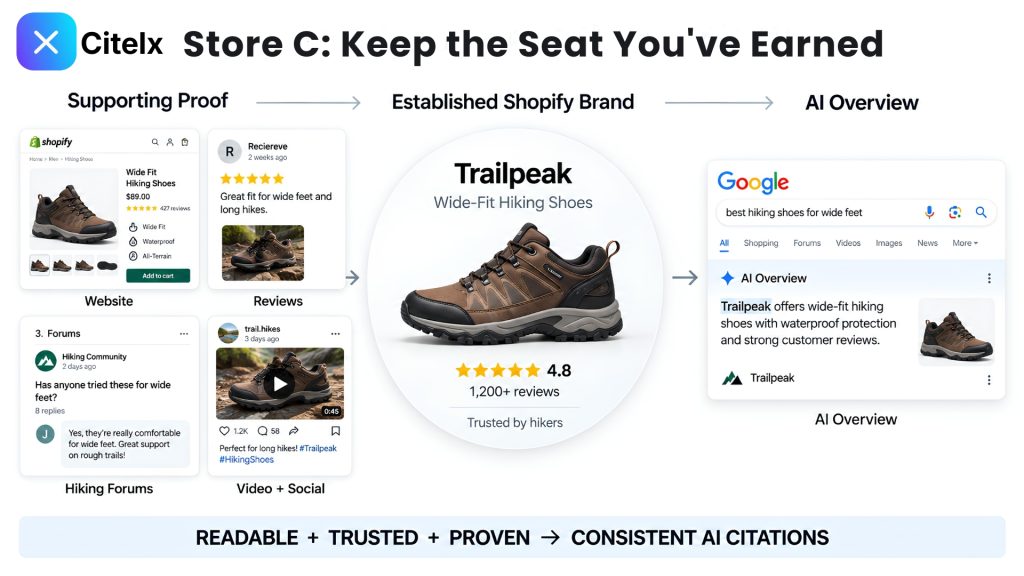
Where you stand right now, trusted and cited. The only real risk is coasting, because authority decays the moment you leave the field. Everything below still runs and keeps improving: refine the product and collection pages, and keep the blog publishing fresh comparison content before a competitor claims the query. On top of that, add the last two layers.
A post-purchase engine
The flywheel that keeps the proof coming.
- Post-order flows that turn buyers into reviewers, photos, and repeat customers.
- The returns and support inbox read back into the pages, since the questions people ask after buying are the ones the page failed to answer before.
- Referral and win-back loops, so every order generates more proof than the last.
CRO for the AI shopper
Because being cited isn’t the finish line, converting the cold visitor is.
- Test the levers that move the sale: title, images, offer framing, and the objections answered near the buy button.
- Make the page convert someone who arrived knowing nothing about you, straight from an AI answer.
The result: you’re not just cited, you convert better than anyone who is. That’s unbeatable, and far cheaper to defend than to rebuild.
Every Store Needs All Six Engines to Get Cited
Each of these engines is another door into an AI citation, and none of them is locked by seniority. Store C’s Google ranking took years, but these surfaces judge every answer fresh, so A, B, and C all start with an equal shot. That makes this the fastest ground any store can gain, so whatever your stage, start working all six now.
The One Rule
AI does not pick the best written copy. It picks the brand it trusts most, the one a machine can read and make sense of. Getting your pages right is what gets you into the conversation in the first place. The full stack, ranking, citation, and authority together, is what wins you the seat and keeps you there.
No matter where you start from, the move is the same. Rebuild your best product’s page and its collection first. Earn real proof that people trust you. Add the systems that keep that proof coming. Then do it again for the rest of your catalogue, one product at a time.