A woman picks up her phone and types this one line: what is the best waterproof hiking jacket under $150? She doesn’t open ten tabs or compare three websites. She waits a few seconds, reads one clear answer with a brand name and a reason, taps it, and buys the jacket.
A brand that spent years climbing to the top of Google just lost that sale and never even saw it coming. A smaller brand that never ranked high just won it. This isn’t something that might happen someday, it happens right now, every day. Shoppers ask questions in a new way, and stores need to catch up.
SEO vs AEO vs GEO: What Each One Actually Means
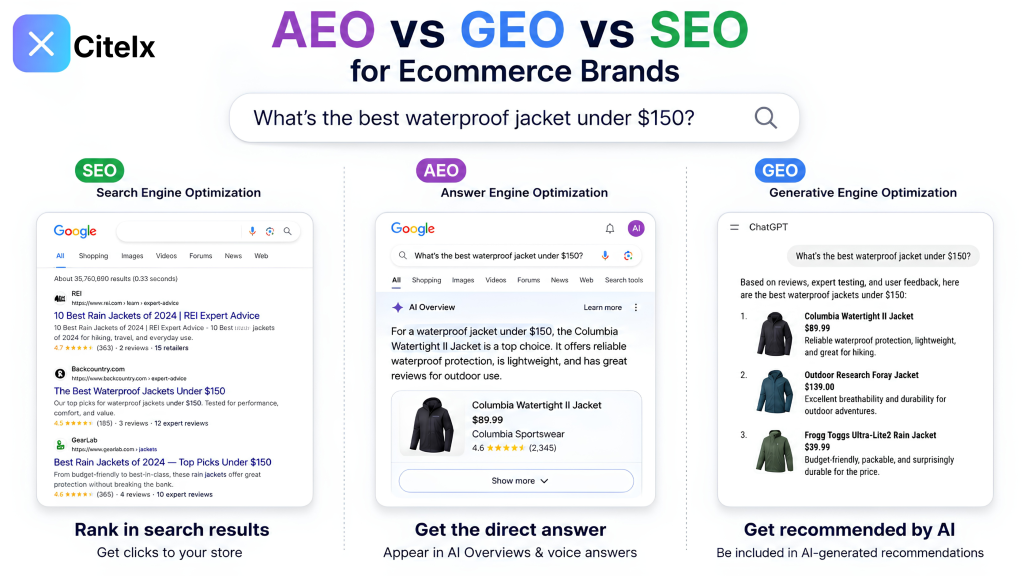
SEO stands for Search Engine Optimization. This is the classic game in which you build a page, Google ranks it, and a shopper clicks the link.
AEO stands for Answer Engine Optimization. Here, the question turns into one direct answer instead of a list of links, like on a voice assistant or Google’s AI Overview. Your content needs to be answered clearly and fast, the way you’d explain it out loud to a friend.
GEO stands for Generative Engine Optimization. This is what happens inside tools like ChatGPT, Gemini, or Perplexity. The AI reads dozens of sources and builds one full recommendation. Your brand needs enough proof scattered across those sources to make that shortlist.
In one line: SEO helps people find you, AEO helps people understand you, GEO helps people trust you. None of these replace each other. They are three steps on the same path.
SEO Is the Ground You Stand On
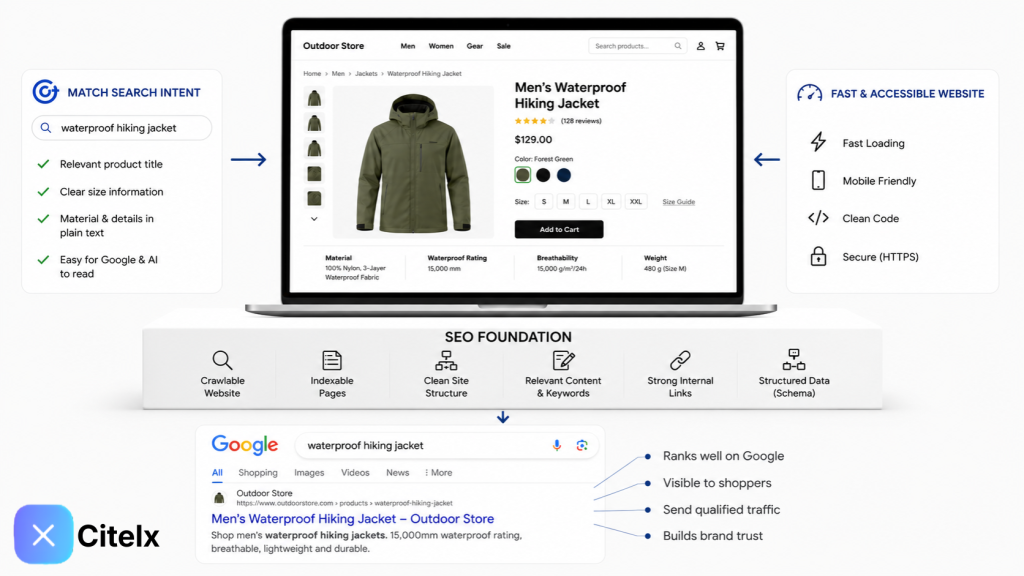
SEO has not gone away. It’s still the base everything else stands on. Your product titles need to match what shoppers type, your pages need to show real size and material details in plain text, and they need to load fast even on a slow connection.
Here’s the part most store owners miss: AI tools often pull facts from pages that already rank well on Google. If Google struggles to read your site, AI probably struggles too. Weak SEO doesn’t just hurt your traffic, it blocks AI from finding anything worth quoting.
AEO Turns Facts Into Clear Answers
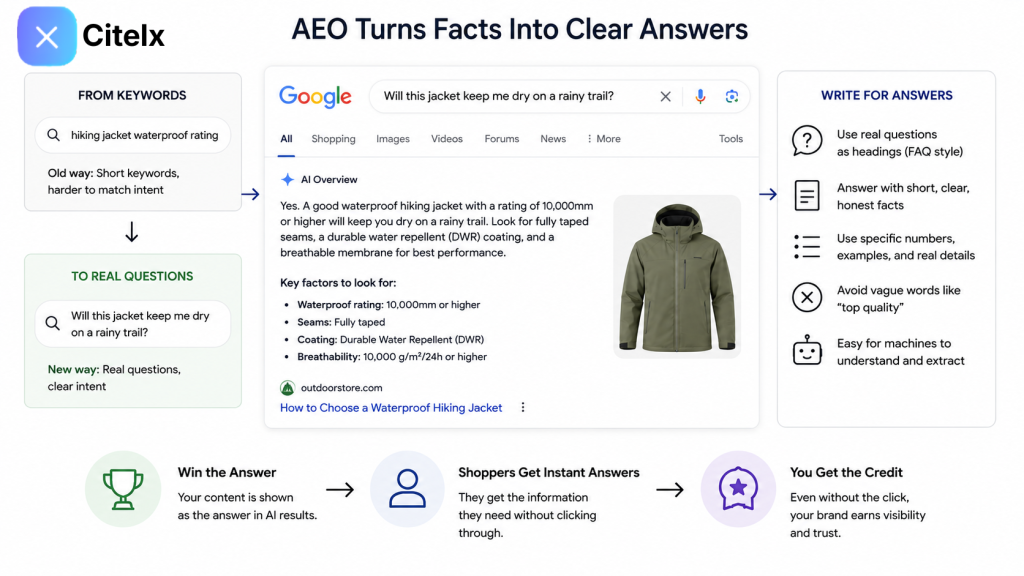
AEO shifts the target from a keyword to a real question. Shoppers no longer type “hiking jacket waterproof rating.” They ask, “Will this jacket keep me dry on a rainy trail?” That’s a different way of writing entirely.
To win that answer, write short FAQs with honest, specific facts. Use headings that match the shopper’s real question, word for word. Skip vague lines like “top quality.” A machine can’t pull meaning out of empty words, and neither can a shopper on her lunch break.
When you win the answer, the shopper sometimes never visits your site at all. You get the credit, but not always the click, and Bain & Company puts that at roughly six in ten searches now. That trade is still worth it, because brands that never show up get neither the credit nor the click.
Why GEO Does Not Cite Most Product Pages
This is the part almost nobody talks about. An AI tool only quotes something it doesn’t already know. It has already read product descriptions from other stores selling something similar, so repeating those same lines adds nothing new, and there’s no reason for the AI to name you as the source.
Product pages are built to sell, not to answer. They’re full of features, shipping info, reviews, and an add-to-cart button. A shopper asking “which jacket lasts longest in heavy rain” isn’t answered by any of that, and the AI can tell. So it looks elsewhere, often to a guide or a forum thread, even one written by a competitor.
This is why being cited now matters more than ranking first. Getting named inside the answer puts your brand in front of the buyer. The number one ranking underneath that answer is just a consolation prize.
Your Category Pages Are Doing Too Little
Most stores pour their content effort into product pages and leave category pages, like “winter jackets” or “gifts under $50,” as a title, a filter bar, and a grid of products.
That’s a mistake. Shoppers rarely ask an AI about one specific jacket, they ask broader questions like “what should I look for in a waterproof jacket.” Category pages match those questions better than product pages and usually carry more search volume too.
A category page worth citing answers what a shopper needs to know before she picks one: what separates good from bad, what’s a fair price, what mistakes people make. A short buying-guide block, a quick comparison of the collection, and a two-question FAQ turn a browsing page into one AI can quote.
What Actually Gets Your Brand Quoted
Almost every page an AI tool quotes shares four things in common.
- A direct answer, right away. Answered in the first two sentences, not buried after four paragraphs of setup.
- Real, specific vocabulary. The exact words a professional would use: materials, sizes, failure points, real measurements.
- Something first-hand. What happens when the product fails, a mistake customers keep making, a test you really ran. This is the one thing a competitor can’t copy, and it’s exactly what earns the citation.
- Brand reputation. A name AI already sees mentioned, reviewed, and trusted across other sites.
Worth knowing: AI can write fluent content all day, but content that only repeats what everyone else says rarely gets picked. What earns a citation is the one thing no model can invent: real, first-hand experience with the product.
GEO Builds Trust You Cannot Fake
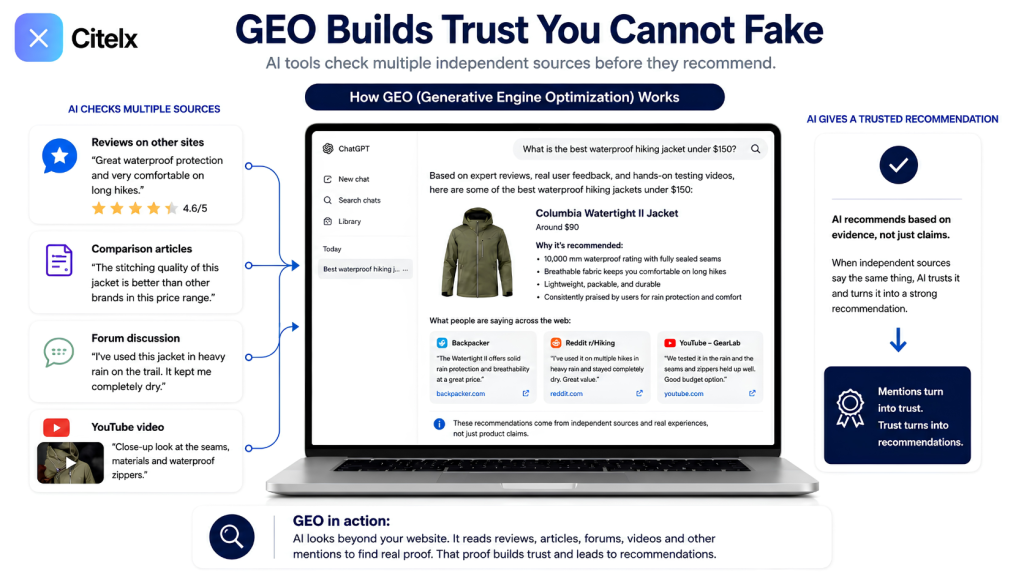
GEO isn’t really about your own website. It’s about everything around it: reviews on other sites, mentions in comparison articles, a forum post where a hiker says your jacket actually works, a YouTube video showing the stitching up close.
AI tools don’t just take your word for it, they check other sources first. If your product page claims the jacket feels comfortable on long hikes, that claim means little on its own. But when unrelated reviews say the same thing in their own words, the AI has real proof, and that’s what turns a simple mention into a strong recommendation.
Search Isn’t Just Google Anymore
TikTok, YouTube, Pinterest, and Instagram are search engines too, each with its own index and its own rules, and most stores post to them without ever optimizing for search there. TikTok indexes spoken words and on-screen text, so buyers search it before they open Google. YouTube playlists rank on their own, and AI answers often quote how-to videos.
Pinterest ranks whole boards, not just single pins. Instagram treats your profile name, bio, and alt text as searchable fields, not decoration. Treating these as just “social proof” is a mistake, they’re separate search engines that need their own keyword thinking.
Where Most Stores Get Stuck
Most stores think product pages, collection pages, and a few blogs are enough. That worked when there was one page to win: a Google result. Not anymore.
The same query now gets asked separately of Google, ChatGPT and other AI assistants, YouTube, TikTok, Pinterest, and Meta AI inside Instagram. Each is its own engine with its own rules. One query split into six answers, and a store needs a place in all of them.
That’s the real shift: YouTube rewards a properly optimized video, not a product description. Pinterest runs on image queries, so pictures need the right title, description, and alt text. TikTok runs on transformational, intent-heavy keywords, what a shopper wants to become, not just what to buy. Product and collection SEO plus a blog still wins Google, but the other five need their own optimization.