Most stores post on Instagram and Facebook hoping for likes, comments, and shares. But there is a second reader looking at every post now, and it does not think the way a person scrolls through a feed. Meta AI is reading these posts too, and it uses what it finds to answer questions and recommend products to other users.
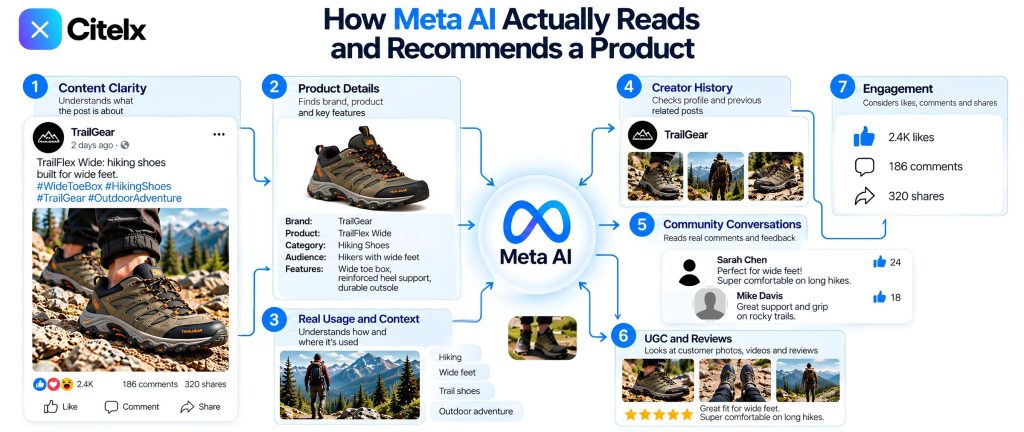
Take a store like TrailGear, selling a hiking shoe called the TrailFlex Wide, built with a wide toe box for hikers with wide feet. When TrailGear posts about it, Meta AI doesn’t read that post like Google reads a webpage, seeing just text and links. Instead, it reads signals specific to the TrailFlex Wide itself: what the post says about the fit, who posted it, how people reacted, and what the comments add about hikers actually wearing it on the trail, all of which decide whether the product should be recommended or not.
1. Content Needs to Be Clear, Not Just Attractive
The first thing Meta AI looks at is whether a post explains what it is about. A nice photo on its own does not tell an AI system very much. It needs the title, the description, the image, the video, and the hashtags to all point at the same clear idea. Here is what that looks like for the TrailFlex Wide launch.
- Title: The first line of the post should say clearly what the post is about. “TrailFlex Wide: our new hiking shoe for wide feet” works far better than something vague like “finally here.” Meta AI weighs the first line heavily, so it should never make the reader guess.
- Description: The caption underneath the title should spell out what the product is, who it is for, and why it helps them. For the TrailFlex Wide, that means saying it is a hiking shoe with a wide toe box, reinforced heel support, and a durable outsole for rocky trails, built for hikers who need extra forefoot room. That is a real description, not just a feeling.
- Image: The photo needs to reflect the exact topic of the post, not just look appealing. A picture of the TrailFlex Wide on a rocky trail, ideally showing the wide toe box the caption is talking about, matches the words. A generic lifestyle photo of shoes with no connection to hiking or fit does not.
- Video: If the post is a video, it should discuss the topic the title and description promise, not just show the product in passing. A video about the TrailFlex Wide should talk about the forefoot room, show the wide toe box, and mention the trail conditions it is built for, the same details written in the caption. A video that only shows someone walking in the shoes without explaining any of this gives Meta AI very little to work with.
- Relevant hashtags: Hashtags should describe the actual product and category, such as wide toe box hiking shoes or hiking shoes for wide feet, instead of generic tags like shoe goals that describe nothing specific.
When the title, description, image, video, and hashtags all describe the same clear idea, an AI system does not have to guess what the post is about. It already knows.
2. Give the AI Clear Entities to Work With
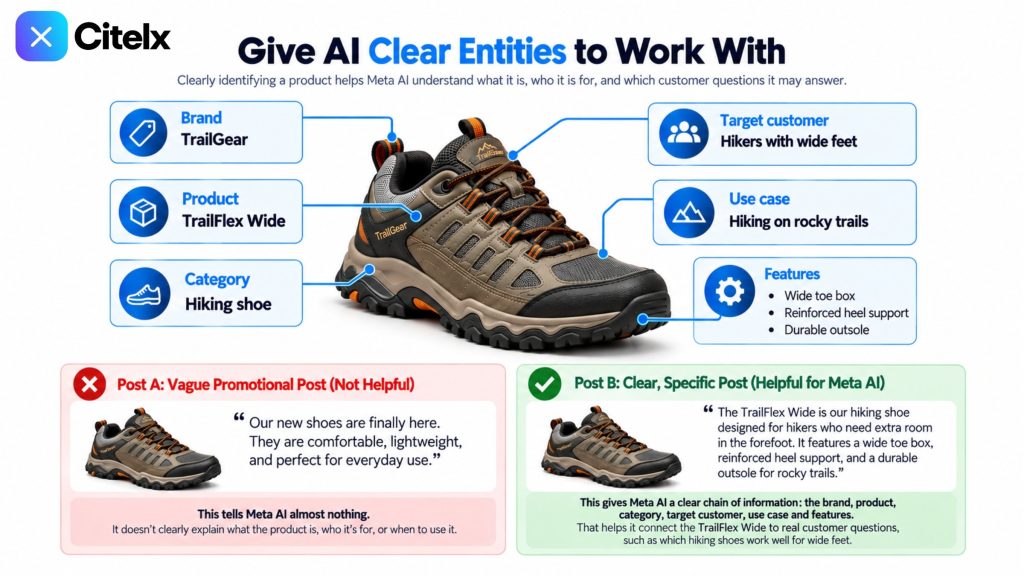
An entity is simply a specific, name-able thing: a brand, a product, a person, a place, a category, or an industry. AI systems work far better with clear entities than with vague, feel-good language.
Compare these two posts about the same shoe.
Post A: Our new shoes are finally here. They are comfortable, lightweight, and perfect for everyday use.
Post B: The TrailFlex Wide is our hiking shoe designed for hikers who need extra room in the forefoot. It features a wide toe box, reinforced heel support, and a durable outsole for rocky trails.
Post A tells the AI almost nothing it can use. Post B gives it a clean chain of information: the brand, then the product, then the category, then the target customer, then the use case, then the specific features. That chain is exactly what allows Meta AI to connect the TrailFlex Wide to a real question, such as which hiking shoes work well for wide feet.
So instead of saying a product is great, explain what it is, who it is for, and why it helps that person. That is what turns a post into something an AI system can use.
3. Context Tells the AI What the Post Is Really About
Meta AI does not read a post entirely on its own. It also looks at where the post sits, which group it was shared in, what thread it is part of, and what topic is already being discussed around it.
A post that simply says “this shoe worked really well for me” means very little by itself. But if that same post appears inside a hiking community where people are already talking about wide feet and forefoot room, and the comments underneath are about toe box space, comfort, and fit, the surrounding conversation makes it clear that “this shoe” is the TrailFlex Wide, and why the post matters to that group.
In simple terms, context tells the AI what conversation is happening and how your post fits into it.
4. The Creator Behind the Post Matters
Who posts matters too. Meta AI weighs frequent posters and occasional posters differently.
The person who posts frequently: Builds a topical history over time, so a post about TrailFlex Wide already reads as credible. Best approach: stay consistent, keep posts specific, and add new details each time.
The person who does not post frequently: Has no history to lean on, so a single post carries less weight. Best approach: make that one post very specific about the product and use case and post it inside a relevant group where the conversation adds context history can’t.
5. Community Conversations Add Even More Context
A single post rarely stays alone. People comment on it, share it, post their own experiences, or mention the brand elsewhere, and Meta AI reads all of that too. Say the brand posts that the TrailFlex Wide gives hikers extra forefoot room. A customer comments that it gave them much more toe room on a fifteen-mile hike, and someone else posts that they switched to it because other shoes felt too narrow.
Now the product isn’t just one sentence, it’s linked to real experiences like wide fit, hiking, comfort, and genuine customer stories, which is exactly what AI systems look for when trying to understand what people think about a product. Comments, replies, and follow-up posts all add to this.
6. UGC and Reviews Also Shape What Meta AI Reads
Meta AI doesn’t only read what brands post, it also reads what customers post and review. A photo of someone wearing the TrailFlex Wide on a real trail, a review mentioning the extra toe room, or a video comparing it to other hiking shoes all count as independent signals, often carrying more weight than the brand’s own post since they read as genuine experience rather than marketing.
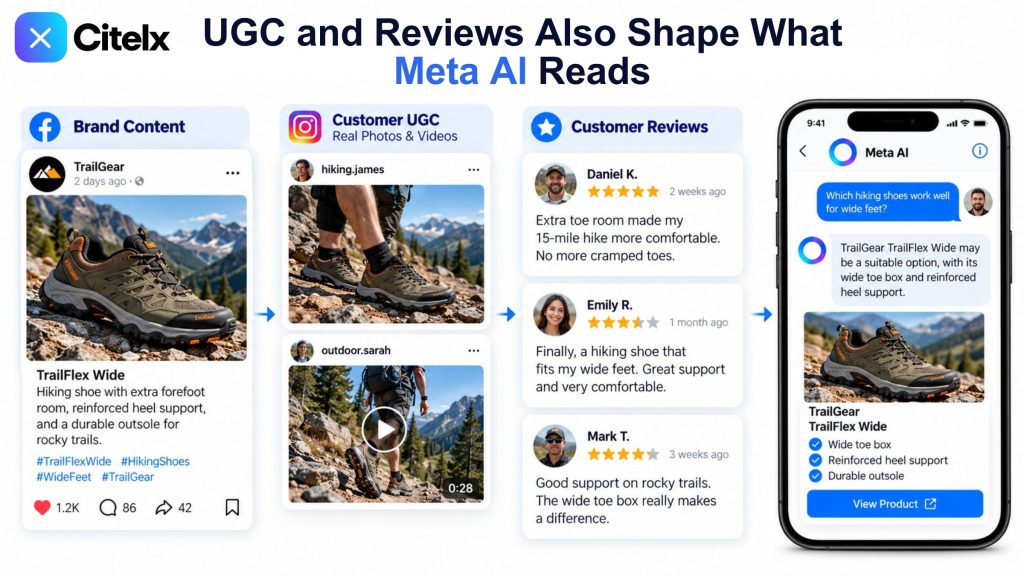
Best approach: encourage customers to share real photos, tag the product, and leave detailed reviews mentioning specific features like fit or comfort, since specific UGC and reviews give Meta AI real proof to cite, not just a brand’s own claims.
7. Engagement Is Not the Same Thing as AI Visibility
A common mistake is assuming more likes mean more visibility in Meta AI. There’s no formula where likes equal citations, engagement is just one part of the picture. Post A, “Our new shoes are finally here, comfortable and perfect for everyday use,” can rack up hundreds of likes for sounding pleasant, but never says what the product is or who it’s for.
Post B, describing TrailFlex Wide’s wide toe box and forefoot room, may get fewer likes but gives Meta AI far more to work with. For real AI search visibility, what a post says matters as much as how much attention it gets. A quieter, specific post can beat a loud one that says nothing at all.
Bringing It All Together
Meta AI reads posts across six layers at once: content clarity, entities, context, creator, community conversation, and engagement. None work well alone, a clear post with no community response is only half the job, and high engagement with vague language is the other half.
The TrailFlex Wide shows what it looks like when all six line up: a clear title and description, matching image and video, specific hashtags, the right hiking community, a creator with real history, genuine comments, and a description specific enough to be cited.